KMILO (Royal Military Institute for Physical Education) and VITO
Breathfit: Exhaled breath analysis to determine physical and mental readiness of soldiers

Case Overview
Voxdale partnered with VITO and the Royal Higher Institute for Defence to engineer a field-ready breath-collection prototype under the Belgian DEFRA program — turning lab-based VOC sampling into a portable, non-invasive tool for monitoring soldier readiness.
Sector
HealthTech · Defence
Client
KMILO and VITO: breath analysis consortium under Belgian DEFRA program
Product
Portable breath-collection system for non-invasive monitoring of soldiers’ physical and mental readiness
Voxdale's role
Engineering, Prototyping, Design for Manufacturing
Technologies
Airtight canister design · VOC stability testing · Mechanical system integration · Iterative field validation · DfM for broader deployment
Partners
VITO (scientific lead) · Royal Higher Institute for Defence · Military Hospital Queen Astrid
Hardest challenge
Translating lab-grade breath sampling into field-robust hardware — ensuring airtightness, VOC stability, and repeatable sampling under real Defence conditions
Outcome
Functional field-ready prototype validated against reference samplers; clear metabolic signatures confirmed in VO₂max field studies; pathway to scalable deployment established
Case Overview
Voxdale partnered with VITO and the Royal Higher Institute for Defence to engineer a field-ready breath-collection prototype under the Belgian DEFRA program — turning lab-based VOC sampling into a portable, non-invasive tool for monitoring soldier readiness.
Sector
HealthTech · Defence
Client
KMILO and VITO: breath analysis consortium under Belgian DEFRA program
Product
Portable breath-collection system for non-invasive monitoring of soldiers’ physical and mental readiness
Voxdale's role
Engineering, Prototyping, Design for Manufacturing
Technologies
Airtight canister design · VOC stability testing · Mechanical system integration · Iterative field validation · DfM for broader deployment
Partners
VITO (scientific lead) · Royal Higher Institute for Defence · Military Hospital Queen Astrid
Hardest challenge
Translating lab-grade breath sampling into field-robust hardware — ensuring airtightness, VOC stability, and repeatable sampling under real Defence conditions
Outcome
Functional field-ready prototype validated against reference samplers; clear metabolic signatures confirmed in VO₂max field studies; pathway to scalable deployment established
Case Overview
Voxdale partnered with VITO and the Royal Higher Institute for Defence to engineer a field-ready breath-collection prototype under the Belgian DEFRA program — turning lab-based VOC sampling into a portable, non-invasive tool for monitoring soldier readiness.
Sector
HealthTech · Defence
Client
KMILO and VITO: breath analysis consortium under Belgian DEFRA program
Product
Portable breath-collection system for non-invasive monitoring of soldiers’ physical and mental readiness
Voxdale's role
Engineering, Prototyping, Design for Manufacturing
Technologies
Airtight canister design · VOC stability testing · Mechanical system integration · Iterative field validation · DfM for broader deployment
Partners
VITO (scientific lead) · Royal Higher Institute for Defence · Military Hospital Queen Astrid
Hardest challenge
Translating lab-grade breath sampling into field-robust hardware — ensuring airtightness, VOC stability, and repeatable sampling under real Defence conditions
Outcome
Functional field-ready prototype validated against reference samplers; clear metabolic signatures confirmed in VO₂max field studies; pathway to scalable deployment established
Executive Summary
Monitoring physical and mental readiness in Defence environments is a persistent challenge.
Blood draws, saliva tests, and self-reporting give medical teams incomplete, delayed, and invasive data — especially during intensive training cycles when fatigue, overtraining, and injury risk peak.
BREATHFIT set out to change that. Under the Belgian DEFRA (Defence-related Research Action) program, VITO, Voxdale, and the Royal Higher Institute for Defence joined forces to build a system that turns something as simple as a breath into meaningful, actionable health data.
Voxdale’s mission was to translate laboratory breath-sampling concepts into a robust, field-ready prototype. The system had to ensure airtightness, VOC stability, and repeatable sampling — all while remaining intuitive to use during training and deployment.
Executive Summary
Executive Summary
Client Context
BREATHFIT is a consortium project funded under the Belgian DEFRA program, which supports defence-related research with civilian spill-over potential.
The scientific lead is VITO, a Flemish research organisation with deep expertise in breath analysis, VOC detection, and data modelling. The Royal Higher Institute for Defence and the Military Hospital Queen Astrid provided operational context, field access, and clinical coordination.
The problem they set out to solve is structural: military training regimens place sudden, intense demands on recruits, but medical teams currently rely on observation and self-reporting to assess readiness. There is no objective, real-time tool to identify individuals at elevated risk of overtraining or musculoskeletal injury before that risk becomes an incident.
The hypothesis: exhaled breath contains volatile organic compounds (VOCs) that reflect physiological load and recovery — and that those signals can be captured non-invasively, in the field, without specialist clinical skills.
Client Context
Client Context
The Technical Brief
Engineer a portable, field-ready breath-collection device suitable for Defence environments
Ensure airtightness and VOC stability from sample collection through to laboratory analysis
Achieve repeatable, standardised sampling across different users and conditions
Validate the device in parallel with established reference samplers (BioVOC-2)
Design for manufacturability (DfM) to enable broader deployment beyond the prototype stage

The Technical Brief
The Technical Brief
The Harder, Less Obvious Part
The challenge was not just engineering a breath sampler, it was engineering one that could survive the gap between a controlled laboratory and an active training ground:
Airtightness under field conditions. Laboratory breath-sampling equipment assumes controlled handling. A field device gets dropped, compressed, and used by people who are physically exhausted. Every seal and connector interface had to be designed for that reality — not just for lab technicians.
VOC stability over time. Breath samples collected in the field are not analysed immediately. The canister has to preserve VOC concentrations from the moment of collection through transport to the laboratory. Even small leaks or material interactions degrade the data. The stability window had to be reliably reproduced across iterations.
Repeatable sampling without specialist training. Recruits and field personnel, not clinicians, would operate this device. The sampling protocol had to be simple enough to execute correctly after a VO₂max test — fatigued, short of breath, under time pressure — while still producing samples comparable to those collected under laboratory conditions.
Parallel validation against a reference standard. Without benchmark data, field results cannot be interpreted. The device had to be deployed alongside the BioVOC-2 reference sampler so that concentrations of key compounds (acetone, isoprene) could be directly compared. That meant coordinating prototype iterations with field study schedules at the Royal Military Institute for Physical Education and Sport.

The Harder, Less Obvious Part
The Harder, Less Obvious Part
What Voxdale Delivered
Voxdale took ownership of the mechanical engineering, system integration, and DfM work across the full BREATHFIT prototype development.
Mechanical design and system integration. Design of the sampler unit from concept through to functional prototype — integrating the breath-collection pathway, canister interface, and valve mechanism into a compact, field-operable form factor.
Leak-proof canister design. Iterative development of the canister sealing approach, with repeated VOC stability testing to verify that compound concentrations remained intact from collection through laboratory analysis. Material selection was driven by chemical inertness, not just mechanical performance.
Prototyping and field validation. Functional prototypes produced and deployed in field validation campaigns at the Royal Military Institute for Physical Education and Sport. The BREATHFIT device was run in parallel with BioVOC-2 reference samplers, generating benchmark data on acetone and isoprene concentrations post-exertion.
Design for manufacturability. DfM analysis to identify the steps required to move from prototype to a device that can be produced at scale and deployed across a broader Defence context — or adapted for civilian health applications.
Collaboration and rapid iteration. Tight feedback loops between Voxdale engineers, VITO scientists, and Defence professionals allowed lab insights to feed directly into hardware design decisions, and field observations to drive the next prototype revision.

What Voxdale Delivered
What Voxdale Delivered
How We Worked
BREATHFIT was a multi-partner consortium project, which meant Voxdale’s engineering work had to be tightly coupled with VITO’s scientific programme and the field study calendar set by the Royal Higher Institute for Defence.
Collaboration between engineers, scientists, and Defence professionals created rapid feedback loops: lab analysis of one field campaign informed the mechanical decisions for the next prototype iteration. Voxdale’s prototyping approach was designed to keep that loop short — hardware changes could be evaluated in the next field session, not months later.
Parallel validation with the BioVOC-2 reference sampler was built into the field study design from the start, ensuring that every BREATHFIT sample had a direct benchmark and that deviations could be traced back to specific design decisions.
How We Worked
How We Worked
The Hardest Challenge, and How We Solved It
The challenge. Ensuring that a breath sample collected in the field, by a fatigued recruit, using a portable device, produces VOC concentration data that is comparable to a sample collected under controlled laboratory conditions — and that this holds up across multiple users, multiple campaigns, and multiple environmental conditions.
Why it was difficult. VOC stability is sensitive to sealing integrity, material selection, and handling. Any one of these can introduce noise that makes two samples from the same individual look different — or makes the BREATHFIT data incomparable to the BioVOC-2 reference. In a laboratory, you control the environment. In a field study, you control the device.
What would not work. Adapting an existing lab sampler for field use by adding a carrying case or simplifying the valve interface. The sampler had to be redesigned around field operating conditions, not retrofitted to survive them.
What we changed:
Sealing from the first concept. Rather than treating airtightness as an integration problem to solve late in development, Voxdale made seal design a first-order constraint. Every component interface was evaluated for leak potential from the initial sketch, and the canister geometry was selected to minimise the number of sealing surfaces.
VOC stability testing as an engineering tool. Instead of testing stability only at the end of a development cycle, Voxdale ran iterative VOC stability tests throughout prototype development. Each iteration was tested against a known concentration standard before going into the field — so field results could be interpreted with confidence.
Protocol simplicity as a design constraint. The sampling sequence was designed to be executable by someone who has just completed a VO₂max test. That meant minimising steps, making the correct operation obvious, and eliminating any step that required sustained attention or dexterity under fatigue.
The Hardest Challenge, and How We Solved It
The Hardest Challenge, and How We Solved It
Outcome
Functional field-ready BREATHFIT prototype delivered and validated across multiple field campaigns.
Parallel validation with BioVOC-2 reference samplers confirmed comparable VOC concentrations — including acetone and isoprene — at collection and post-exertion timepoints.
Field studies at the Royal Military Institute for Physical Education and Sport demonstrated clear temporal shifts in metabolic signatures following VO₂max tests, with increased VOC signals immediately and one hour after exertion, followed by recovery.
Early analyses show correlations between breath-based principal components and self-reported fatigue and performance decline, confirming that exhaled breath reflects physiological load and recovery trends.
Machine-learning analysis combining breath data with heart rate and psychological questionnaires identified patterns linked to fatigue, vigour, and total mood disturbance.
Modular setup enables future adaptation for overtraining detection, sports performance monitoring, occupational health, and preventive healthcare.
Outcome
Outcome
What This Proves for Similar Teams
BREATHFIT is relevant for research institutions, Defence agencies, and HealthTech product teams working on non-invasive biomarker sensing — where the gap between laboratory validation and field deployment is not just technical but operational. The device has to work in the hands of non-specialists, in unpredictable environments, producing data that scientists can trust.
This case shows how Voxdale approaches that class of problem: mechanical engineering and DfM expertise applied inside a multi-partner consortium, with rapid iteration driven by real field data rather than laboratory assumptions, and a clear line from prototype to scalable deployment.
What This Proves for Similar Teams
What This Proves for Similar Teams
Ready to take a lab-validated concept into the field?
Voxdale engineers non-invasive biomarker and sensing devices that hold up outside the lab — built for real users, in unpredictable conditions, with data scientists can trust. Explore our Life Sciences & Medical engineering capabilities or contact us to discuss your sensing or diagnostic challenge.
Continue reading
Continue reading

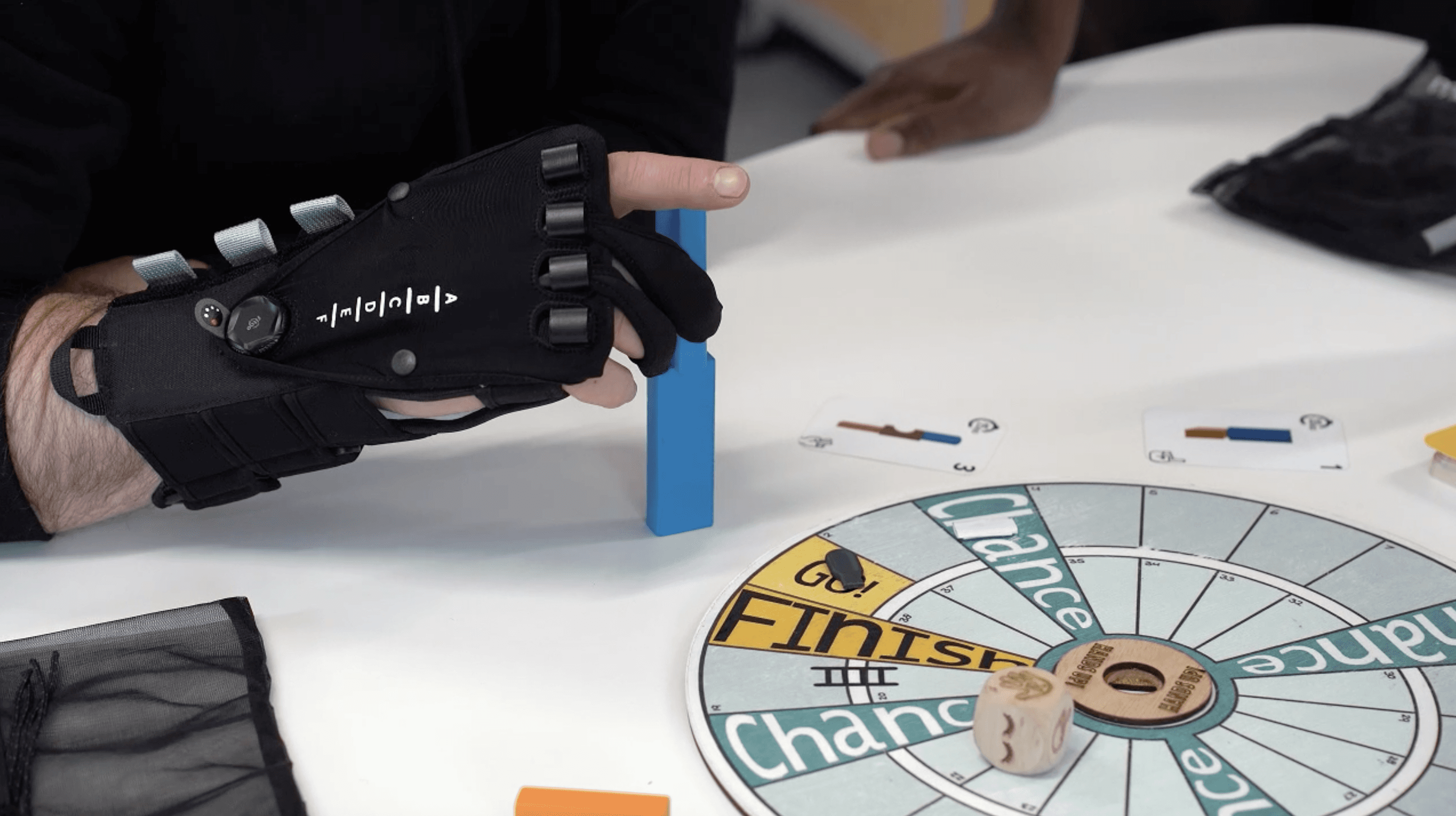
Madglove
From a physiotherapist's insight to a manufacturable assistive glove for people with hand spasticity

Ceriter
Engineering the next-generation gait sensor electronics for Ceriter's Stride One platform

Aseptic Technologies
Engineering a principle-first mixing-and-cooling system for cell-therapy manufacturing

Heau
One architecture, two products: engineering Heau’s instant-hot-water shower as both a retrofit and a built-in unit

Institute of Tropical Medicine
Designing a $2 blood self-sampling device for home use — from first prototype to peer-reviewed results, a patent, and a Red Dot Award

© 2026 Voxdale BV
© 2026 Voxdale BV
© 2026 Voxdale BV
Wonderful ideas, engineered from sketch to scale
Wonderful ideas, engineered from sketch to scale
Wonderful ideas, engineered from sketch to scale
Wonderful ideas, engineered from sketch to scale